• The Durotriges website
June 2008
Durotriges

Turnpike: Bridport First District Trust

Formed in 1764-5 from part of the 'Great Western Turnpike' it served Bridport, Chideock and Charmouth until expiring on 1 Nov 1877.

The Bridport First District Trust [Show/Clear] was formed under the 1764-5 (5 G 3 c.75) Act from Penn Hill, Lyme Regis to Askerswell Hill, Bridport. This included the Bridport Harbour (West Bay) road but no date is known. These roads were originally part of the western section of the 'Great Western Turnpike', the second turnpike in Dorset, created in the 1753-4 (27 G 2 c.32) Act. Extended in the 1755-6 (29 G 2 c.54) Act through Dorchester and Blandford, to Harnham Hill near Salisbury.

The remainder of the Great Western Turnpike was split up into several Trusts. Two Devonshire trusts covered the western roads including the Axminster Trust, incorporating the Dorset section from Raymond's Hill to Penn Hill. The northern route from Bridport to Beaminser became the Bridport Second District Trust. The eastern remainder through Dorchester and Blandford, to Harnham Hill near Salisbury became the Harnham, Blandford and Dorchester Trust.

The Bridport First District Trust continued, without change, under the 1798-9 (39 G 3 c.33) and 1818-9 (59 G 3 c. 87) Acts. The 1824-5 (5 G 4 c. 97) Act included powers to make new cuts or diversions to ease the western routes.

The first was for "a new cut or piece of road from the west end of the village of Chideock into the present turnpike road at a place in the parish of Chideock near a certain highway to Ryall". The plan indicates that the first was intended to make the ascent of Chideock Hill more gradual by taking the road a little to the north-east, but it would seem that this was reduced to making the present half mile or so from the top of Chideock Hill to Morcombelake, which replaces the continuation of Langdon Lane a little more to the west.

The second was "a new cut from Morcombelake leading into the present turnpike road at a place in the parish of Whitchurch Canonicorum between the 5th and 6th milestones near Barn Lane". This was a more important provision which switched the turnpike from from the old and difficult route along the flank of Stonebarrow Hill to the line which it now follows. At Morcombelake there was a well-known inn called the Ship on the old road, and this was moved to its present position a little rurther north, the old house becoming Ship Farm.

The third was "a new cut from the turnpike road near the garden in occupation of Andrew Tucker in Whitchurch Canonicorum, through the parish of Catherston into the turnpike road at or near Charmouth Bridge".

The plan also shows that the third cut was intended to run direct from Bellair to Charmouth Bridge. It is scarcely surprising that it was never made since it would not only have duplicated the existing road from Bellair to Newlands but would have crossed the valley of the Char much more obliquely, and it may thave been in connection with this, or in substitution for it, that Charmouth Bridge was rebuilt in 1824.

Location

See map below

Note: Certain browser and security restrictions may not permit the following location display.

  Clear all overlays
Bridport First District Turnpike
Toll Houses.

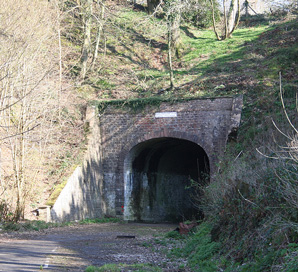
The fourth was "a new cut from Langmoor in the parish of Charmouth into the turnpike road at a place in the parish of Whitchurch Canonicorum near Penn Inn". This was very important taking the turnpike on both sides of the Penn Cross further eastwards and made it much easier by tunnelling through the summit of Thistle Hill. This considerable feat of road engineering was completed in 1832 and its opening signalled by the passing of two Exeter coaches in it. These alterations were completed by 1835 and thereafter there were no more road changes, and the Trust was renewed in 1855 (18, 19 Vitc. c. 15).

The Trust had 15 miles of road and, latterly, five turnpike gates and four side-bars. Three of the gates were at Bridport, i.e. East Gate, near East Street Railway Station; South Gate, in the corner of the road to Vearse, and still standing; and West Gate. In Taylor's time this last was as far out as the point at which the Eype Down road goes off, but it was later moved to West Allington, where an excellent toll-house of late date still stands. There was a gate at Charmouth where the Wootton Fitzpaine road branches off between the two rivers, and here again a toll-house, matching the others, still stands. The fifth gate was described as at Cuckold's Corner, which is at the point at which the road from Higher Sturthill meets the main road near Askerswell, but there is no trace here of a house.

The Trust expired on 1 November 1877 (40, 41 Vict. c. 64).

Toll Houses

During the Trusts existance it had five Toll Houses [Show/Clear] situated along the roads to collect tolls. One, at West Gate, was moved whilst others have been demolished.

Image

Charminster

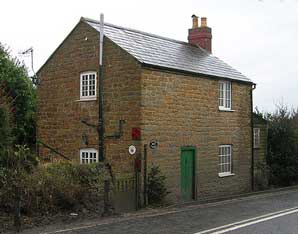
Built at the Wootton Fitzpaine road junction, between the two rivers (River Char).

Image

West Gate at Eype Down

The original toll house possibly built by the Harnham, Blandford and Dorchester Trust predating the Bridport First District Trust. It was replaced by a new house at West Allington.

Image

West Gate at Allington

The new toll house built by the Trust to replace the one located at Eype Down.

Image

South Gate, Bridport

Toll house built on the Bridport to Bridport Harbour (West Bay) road at its junction with the road to Vearse.

Image

East Gate, Bridport

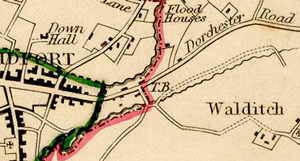
Reported as being near the River Asker bridge. This Creighton 1835 map places it (TB) 150 meteres west at the junction with Walditch.

Image

Cuckold's Corner, Askerswell Hill

No trace of a house at this reported location at the junction of the road to Higher Sturthill. Probably demolished in later road improvements.

Tunnel
Charminster Road Tunnel 1832

Charmouth Tunnel

Opened in 1832, with the passing of two Exeter coaches, it reduced the climb over Thistle Hill. The third english road tunnel predates the other Dorset tunnel through Horn Hill by six months.

It was 73 yards long, 20 ft wide and an elipical arch roof over 13ft high walls

Milestone
Milestone Bridport 4, Axminster 6

Milestone

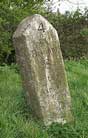
Laterly the Trust had 15 miles of road along which stood milestones. Most were removed during WWII or through later road improvements. However, just west of Charmouth Tunnel, this one remains, inscribed “4 to Axminster, 8 to Bridport”.

Side Bars

Side-bars

It is reported that the Trust include four side-bars to control access to the Turnpike. At present their location is not recorded.

Bridges

Stone Bridges

Who was responsible for bridge repairs seems uncertain but the following was recorded in 1831, based on a 1791 return:

Bridport
East: Town, Bradpole and Walditch parishes.
South: Ditto, and Bothenhampton, Symondsbury parishes.
West: The Town.

Trust
D Viner

Charmouth
Charmouth: County - 1823. (The bridge was rebuilt in 1823.)
Chideock
Chideock: Turnpike or Parish - not recorded

Newlands: Catherston Leweston & Whitchurch Canoncorum parishes

Trust Members

The Trust Members

Currently members of the Trust is not known.

Public houses and inns

Hostelries

To serve the thirsty and tired travellers the following hostelries have been identified. From East of Bridport; Travellers' Rest. Bridport; Unidentified PHs. West of Bridport; London Inn (Previously Exteter Inn?). Chideock; Castle Inn. Morecombelake; Ship Inn, moved when route realigned, (Rising Sun?). Charmouth; Coach & Horses Hotel, Unidentified PH. Penn; Penn Inn and to Hunter's Lodge on the Axminster Trust Turnpike.

Turnpike Trusts

By the mid 18th century it was apparent that the parish based road system with statute labour intoduced in the 1555 Act failed to provide the growing need to fund and develop an improved nationwide road system. A turnpike system had been introduced in 1663 as part of the Great North road improvement. In 1706 the first turnpike trusts were introduced in and around London. In 1752-3 the first trust, the Shaftesbury and Sherbourne Trust was introduced in Dorset.

The Trust, setup by a local group, empowered by an Act of Parliament, raised capital for new construction and repair of old roads recovering this out of tolls levied on the road user. Such Acts were for a period of twenty-one years and renewed through a series of local or statute, requiring new powers, continuation acts. Several trusts were consolidated as part of the General Turnpike Act of 1773 whilst others were split into Divisions. Later the rights to collect the tolls was leased to the hightest bidder. Initially it was expected that such Trusts would maintain the road, pay a dividend and repay the initial capital. Strangely most trusts continued to exist because they were a financial failure, unable to repay the capital and needing relief acts, rather than a success.

The term turnpike relates to the hinged gate, set across the road opened when a toll had been paid to the turnpike-keeper in his adjoining toll house. These were setup along the route as were milestones giving the traveller an indication of his progress. Once the roads had been improved old roads may be stopped or gated to eliminate toll avoidance.

From 1850s railways started to compete for long distance goods transport reducing road traffic and hence toll revenue. From the late 1870s Trusts were wound up and their powers expired. These, and other main roads, became the responsibility of the new County Councils formed in 1888.

Bibliography

Good, Ronald. “The Old Roads of Dorset”, Bournemouth, Horrace G. Commin Ltd, 1966 : Amazon
Eedle, Marie de G., “Horn Hill Tunnel”, Bridport, Eedle, 1994 : Amazon
The Book of Beaminster: And Local Village Life", (Halsgrove Portrait)
Viner, David. "Discover Dorset. Roads, Tracks & Turnpikes", Wimborne, Dovecote Press, 2007

Links

Some primary sites that provide Dorset related information

Administration

Main site link to current county, district and parish councils

Archives

Archives and Museums

Geneology

Information, help and assistance in Dorset family history

Historic Links

A range of historic information sources

Mapping

Historic mapping

Geographic information

Current mapping

Image